
Bending and welding sheet metal: processes, techniques and applications
How a flat sheet becomes shell rings, tanks or structures: forming techniques, the variables to control and the welding that follows.
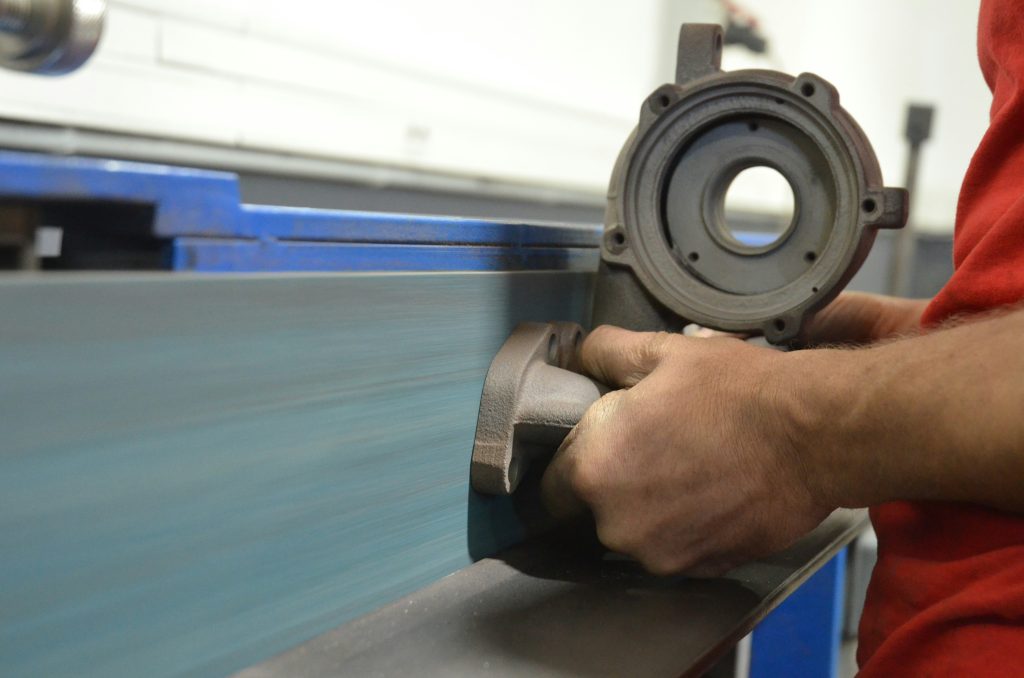
Bending and welding sheet metal are two fundamental processes in industrial manufacturing and metalwork. These techniques make it possible to turn a flat sheet into parts with cylindrical, curved or more complex geometric shapes and then join different components to build structures, tanks, hoppers, ducting and all kinds of metal assemblies.
Sheet metal stands out for its versatility and can be supplied in different materials, thicknesses and finishes. Depending on the needs of each project, it is possible to work with carbon steel, stainless steel, aluminium or other metals, then select the most suitable forming and welding process.
At Ikalder we carry out cutting, forming, assembly, welding and finishing work for companies and industrial projects, bringing different processes together in the same workshop. This allows manufacturing to be handled from the initial preparation of the material through to the final finish of the part.
What is sheet metal bending?
Sheet bending is a forming process in which the geometry of a metal sheet is altered to obtain a particular shape.
To achieve a good result, factors such as the thickness of the sheet, the type of material, the length of the part, the bend radius and the mechanical behaviour of the metal all have to be taken into account.
For this reason, industrial bending must be carried out with the right machinery and a precise understanding of the characteristics of the material.
Unlike cutting, bending removes no material. The sheet is deformed by applying force in a controlled way until it reaches the radius, angle or geometry specified in the design.
Main sheet bending and forming techniques
There are different methods for transforming a metal sheet. The choice will depend mainly on the shape required and on the characteristics of the part.
Sheet folding
Folding produces defined angles and shapes by applying pressure to a specific area of the sheet.
It is a common process for manufacturing supports, sections, housings, frames and other industrial components.
Accurate positioning and control of the fold angle are essential if the parts are to be assembled later without difficulty.
Sheet rolling
Rolling is used to turn a flat sheet into a curved or cylindrical surface.
To do this, the sheet usually passes between several rolls that apply pressure progressively until the desired radius is reached.
This process is particularly useful for manufacturing tanks, shell rings, pipework, cones, ducting and other items used in industrial metalwork.
Ikalder has machinery for folding, rolling and bending both sheet metal and tubing.
Bending tubing and sections
Forming is not limited to flat sheet.
Tubing, sections and other metal items can also be bent to produce geometries suited to particular structures or assemblies.
This type of work is common in metal structures, furniture, industrial components and bespoke items.
What makes for good sheet bending?
Producing a correctly formed part means controlling a number of variables throughout the process.
Type of material
Each metal responds differently to deformation.
Carbon steel, stainless steel and aluminium have different mechanical properties, so the working parameters must be adapted to the material used.
Ikalder works with a range of metals, including:
Sheet thickness
Thickness directly determines the force needed to bend the sheet and also the minimum radius that can be achieved.
A thin sheet behaves differently from a thicker one, so the machinery and the procedure must be chosen according to these characteristics.
Bend radius
The radius indicates how tightly the part will be curved.
A radius that is too small for the thickness or the characteristics of the material can cause stresses, marks or unwanted distortion.
It is therefore important to study the design beforehand and work out the correct flat developments before manufacturing begins.
How do bending and welding work together?
On many industrial projects, bending is only one of the early stages of the manufacturing process.
Once the sheet has been formed, its ends may need to be joined, or it may need to be combined with other parts by welding.
To manufacture a cylindrical shell ring, for example, the starting point is usually a flat sheet. It is cut to the intended dimensions, rolled until the required geometry is reached and then its ends are welded together.
EXAMPLE · MANUFACTURING A SHELL RING
The same applies to the manufacture of tanks, hoppers, cones, elbows and reducers.
Coordination between the two processes is essential if the parts are to fit correctly and hold the specified dimensions.
Welding techniques used after bending
The choice of welding procedure will depend on the material, thickness, geometry and final requirements of each project.
TIG welding
TIG welding produces precise joints with a high degree of control over heat input.
It is especially common on work calling for a careful finish, or when working with materials such as stainless steel or aluminium.
MIG/MAG welding
MIG/MAG welding offers high productivity and works with a range of thicknesses and materials.
It is frequently used on metal structures and industrial assemblies where strength has to be combined with speed.
ROBOT
LASER
Robotic and laser welding
Automation also plays an important part in metal manufacturing.
Robotic welding maintains high repeatability on production runs, while laser welding can offer great precision and a concentrated heat input.
Ikalder has a range of welding processes, including:
Applications of sheet metal bending and welding
Combining forming and welding makes it possible to manufacture a huge variety of metal products and components.
INDUSTRIAL METALWORK
Industrial metalwork covers the manufacture of tanks, hoppers, cones, elbows, reducers and various cylindrical or conical parts.
METAL STRUCTURES
In metal structures, these processes are used to produce frames, supports, enclosures, canopies, staircases, railings, gates and other bespoke assemblies.
Ikalder uses these processes on projects for sectors such as:
The benefits of bringing bending, welding and finishing into one workshop
When the different stages of manufacturing are carried out in a coordinated way, dimensional control of the parts improves and unnecessary movement between suppliers is reduced.
The process can begin with a feasibility study and the choice of material, continue with cutting and forming the sheet and end with assembly, welding and surface treatment.
Bringing it together also makes it easier to make adjustments between stages when the project calls for it.
Ikalder brings together five main processes:
Bespoke sheet metal bending and welding at Ikalder
Every industrial project has different requirements for dimensions, material, tolerances and finish.
Before manufacturing begins it is therefore important to study the drawings, work out the flat developments correctly and select the right forming and welding techniques.
At Ikalder we manufacture metal structures, parts in metalwork and bespoke components, working with sheet metal, tubing, sections and flat bar.
Our ability to bring together cutting, bending, rolling, folding, welding and surface treatments lets us develop projects tailored to the needs of each company.
Do you need a metal part or assembly manufactured?
Send us the drawings, material, dimensions and expected quantities and we will work out the most suitable manufacturing solution.